
73 percent of smartphone users say listening to music has a positive effect on their wellbeing
Qualcomm believes that sound is more important than ever, as it’s at the heart of so many of our technology interactions – like making calls, playing games, listening to our favorite music, and watching video clips on social media.
In fact, research from Qualcomm’s 2021 State of Sound Report indicates that 62 percent of smartphone users now rely on their audio devices as part of their daily lives. In 2021, use of true wireless earbuds increased across all activities, illustrating the acceleration of all-day wear behavior, and listeners’ diversifying requirements for sound. More importantly, and unsurprisingly, 73 percent of smartphone users say listening to music has a positive effect on their wellbeing – which is why Qualcomm believes the benefit of premium sound experiences should be shared by all.
Underpinning these ever-evolving adoption trends are advances in sound technology, like, says Qualcomm, the studio master sound quality offered by Snapdragon Sound technology. An optimized chain of audio software, Snapdragon Sound brings together audio, connectivity, and mobile innovations designed to provide a premium, low-latency, robust sound experience for music, calls, and gaming.
It’s because of innovations like these that end-users can benefit from wireless audio devices that deliver sound that’s as good as a wired connection. And that their increasingly high expectations for how they experience their technology interactions are being met.
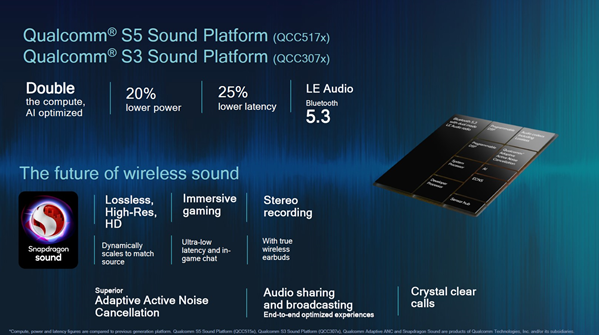
This is why, says Qualcomm, it continues to invent leading audio tech, like its two new ultra-low power platforms – the Qualcomm S5 Sound Platform and Qualcomm S3 Sound Platform – for true wireless earbuds, speakers, and headsets.
With Snapdragon Sound technology, Qualcomm claims that these platforms include a ton of exciting innovations – and are purposefully designed to help its customers stay one step ahead with the most-wanted features and new use cases in sound.
Qualcomms believes that it has made it possible to deliver all this, and a whole lot more, by re-architecting its ultra-low power Bluetooth audio design to provide double the compute (compared to the previous gen), with no compromise to the ultra-low power performance.
It has also delivered three times the memory in the Qualcomm S5 Sound Platform compared to theprevious gen platform, with new optimizations for AI. Not only has this helped the platform be efficient, says Qualcomm, but its customers now have the ability to implement AI-based audio features.
Related Articles

Semtech and AWS Collaborate on AWS IoT Core for LoRaWAN
Fully managed feature for AWS IoT Core enables enterprises to connect low power wireless devices to long range wide area network technology Semtech Corporation, a supplier of high performance analog and mixed-signal semiconductors and advanced algorithms, has...

Hyperscalers play an increasingly important role in the IoT platforms market
IoT platforms provide middleware to connect and manage devices and integrate collected data into various applications and services. According to a new research report from the IoT analyst firm Berg Insight, the global market for IoT device management and application...

Global Certification Forum launches new accreditation initiative for Consumer IoT Security
GCF has been working closely with its partners to ensure that the industry actively addresses all aspects of security in the market The Global Certification Forum (GCF) has launched a consumer IoT security accreditation programme which is apparently available to any...
Stay Up to Date With The Latest News & Updates
Our Sponsors
Incisor.TV partners with leading organisations in the technology sector.



Follow Us
And stay up to date with our news! We are active across the key social media platforms – please do follow us!
0 Comments