
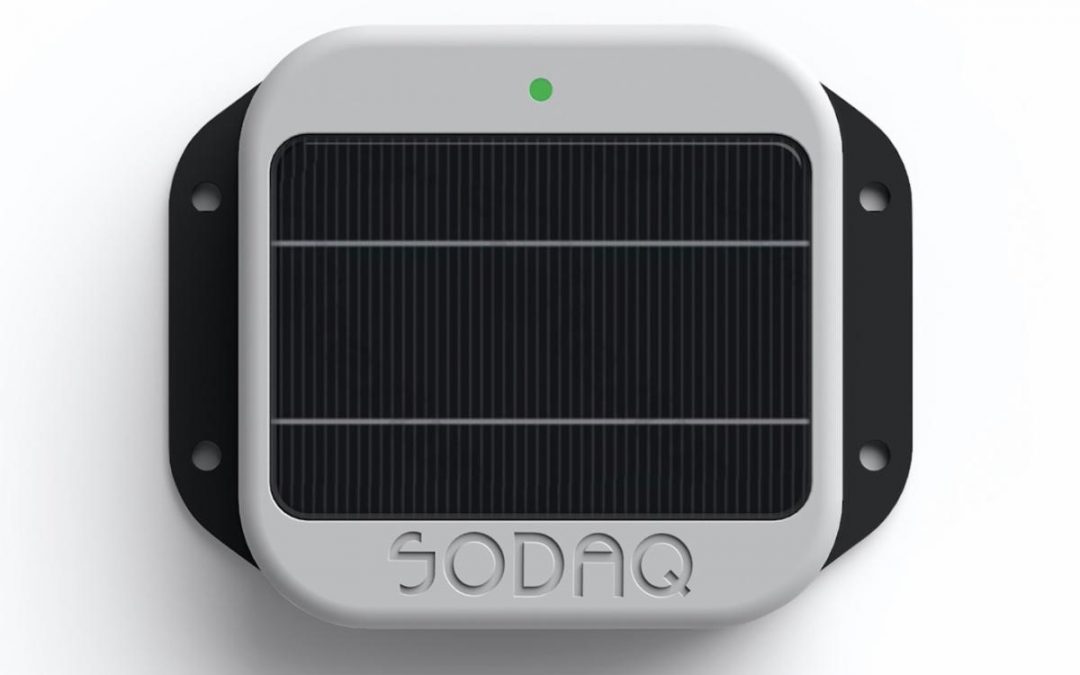
Batteryless version can operate perpetually on harvested solar energy alone
Nordic Semiconductor tells us that Dutch engineering and design specialist, SODAQ, is using a Nordic multi-mode NB-IoT/LTE-M nRF9160 System-in-Package (SiP) in what is claimed to be the world’s first solar-powered, perpetual operation cellular IoT asset tracker.
The miniaturized 80 x 80 x 11.5 mm SODAQ TRACK SOLAR device forms parts of the SODAQ TRACK asset tracking range (which includes an additional two more battery-powered variants targeting theft detection and parcel tracking and monitoring) and weighs just 100g. In low duty cycle applications comprising up to eight pings a day, SODAQ says the asset tracker will operate perpetually on harvested solar energy alone. This is said to make the tracker ideal for a wide range of logistics, offshore, site management, and general asset tracking applications.
The tracker integrates a light sensor, accelerometer, temperature sensor, and status LEDs, and is powered from a 0.5W solar panel. It also offers a positional accuracy of 5-20m for GPS, 10-50m for Wi-Fi, and 100m+ for cellular.
“As the IoT moves into having hundreds of billions of devices installed worldwide, batteries suddenly become an important issue,” commented SODAQ CEO, Jan Willem Smeenk.
Smeenk continued: “First there is the cost issue of having to check and replace batteries which in large IoT installations quickly become the single biggest cost factor over an IoT product or sensor’s lifetime. And this cost factor will become even more significant as the data subscription costs for cellular continue to fall to what I predict will be around $1 a year before long.
“Second there is the environmental impact of having billions of batteries wasted every year. To me, therefore, the future of IoT really does need to be batteryless and therefore self-powered wherever possible. And so the SODAQ TRACK SOLAR is a firm a step in that direction for cellular IoT.”
Smeenk said that the SODAQ TRACK SOLAR is able to operate without a battery by using the available hardware and software in the best possible way: “This includes the low power characteristics of the Nordic nRF9160 SiP itself, and obeying the three golden rules of low power IoT design: Sleep as often as you can, work or go active for as short a period as possible, and communicate as briefly as possible when on-air.”
Related Articles
The world’s first non-cellular 5G connection demonstrated in Finland
Wirepas and Nordic Semiconductor staged a demonstration of DECT NR+ at the recent ETSI TC DECT#94 plenary meeting that took place in Finland. Massive IoT is becoming a reality with the non-cellular 5G Mesh. A test network acts as the product proof of concept...

STMicroelectronics, in collaboration with Thales, powers secure, contactless NFC convenience in Google Pixel 7
ST54K single-chip NFC controller and secure element combines with Thales secure OS in embedded SIM, transit ticketing, and digital car-key applications STMicroelectronics has revealed that its ST54K IC is handling control and security for contactless NFC communication...

Onboarding IoT devices on secure IT networks
By Michael R. Tennefoss, Vice President of IoT and Strategic Partnerships, Aruba, a Hewlett Packard Enterprise company Building owners and tenants are rapidly transforming workplaces into energy-efficient smart spaces. This has amplified a problem that has long faced...
Stay Up to Date With The Latest News & Updates
Our Sponsors
Incisor.TV partners with leading organisations in the technology sector.



Follow Us
And stay up to date with our news! We are active across the key social media platforms – please do follow us!
0 Comments